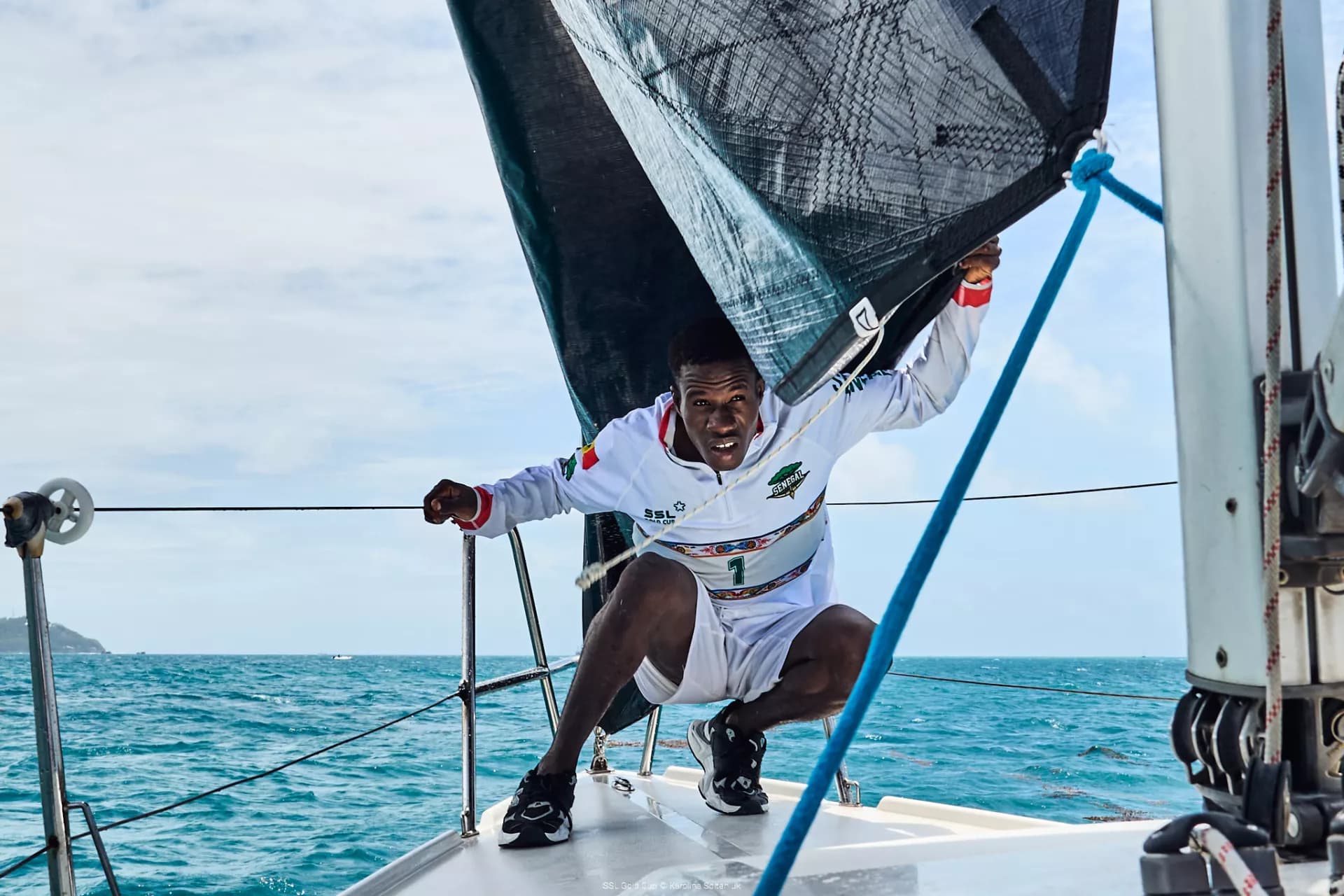
For SSL Team Senegal, the training camp in Seychelles marks the beginning of a new chapter. With 10 young sailors coming from different sailing backgrounds, the team is discovering a completely new challenge: moving from individual sailing to working together as one crew. As part of the SSL Team Community, Senegal is taking its first steps towards building a team capable of competing at the highest level, with future SSL Gold Cup editions and the African continental qualifiers in sight.

And they are doing it in some of the most demanding conditions they could have faced for their first steps on the boat.
With winds regularly exceeding 20 knots, frequent rain and challenging conditions on the water, the Seychelles training camp has been a real test from the very beginning. For a team experiencing this type of sailing together for the first time, learning how to handle the boat, execute manoeuvres and develop coordination in such conditions is no small achievement.
Yet the Senegalese sailors have embraced the challenge.
“Today we are very happy to be here for the first time. Senegal has been in Seychelles for training, for assisting in the training of SSL group,” says the team's representative.
After only a few days on the water, the feeling is already clear: the experience is both exciting and challenging.
“I say exciting and challenging. Exciting because it is the first time that we were there with 10 young sailors. Challenging because we have a lot of things to learn.”

Learning from Experience
The challenging conditions in Seychelles are also an important part of the learning process — but the Senegalese sailors are not facing them alone. The team is training under the guidance of experienced coaches and sailors, including Allan Julie, captain of SSL Team Seychelles and an Olympic sailor, as well as coach Rigo de Nijas.
For a group of 10 young sailors taking their first steps in this type of team sailing, having such experienced figures alongside them provides an exceptional learning environment. Their guidance is particularly valuable in conditions that are demanding even for experienced sailors.
With winds regularly exceeding 20 knots and rain adding another layer of difficulty, the Senegalese team is being tested from the very first days of the camp. At the same time, they are receiving expert guidance on how to handle the boat, understand their roles and, most importantly, develop the coordination needed to sail as one team.
For these young sailors, the Seychelles camp is therefore much more than simply their first training experience on an SSL boat. It is an opportunity to learn from experienced sailors and coaches, build confidence in demanding conditions and develop the foundations of a team that could represent Senegal on the international stage in the future.

From Individual Sailing to One Team
The sailors arrived in Seychelles with a variety of backgrounds. Some are kite surfers, others windsurfers, while some have experience as leisure sailors. What they have in common is their connection with the water — but the SSL format is teaching them that sailing as a team requires a completely different approach.
“We have some kite surfers, some wind surfers, and also some leisure sailors. But all this is like a single sailor, and here we need to build a team, teamwork.”
That transition has quickly become one of the team's main objectives.
“From now on, everything that we do is like discovering how this kind of boat be sailed and everything. And now our next goal is to improve it and to get better and better in the coordination and all of these things.”
He explains that the team is learning to move away from individual sailing and understand the importance of working together.
“Because we used to sail like one single sailing and now this is a team and we discovered that we need to improve our coordination and this is our next objective.”
In the strong Seychelles breeze, that coordination is being tested from day one. Every manoeuvre requires the sailors to understand their roles, react quickly and work together — something that takes time to develop, especially when the team is still becoming familiar with the boat.
Despite the demanding conditions, however, the team remains positive about the progress they are making.
“We are discovering all this kind of, and yes, it will come in more understanding and more coordination, I think, so we're going to get there.”

The conditions in Seychelles also highlight something that could become one of Senegal's greatest strengths in the future: its coastline.
“We found it so nice, and especially in Senegal we have a big coast and we have also big wind there and people like to water.”
For a country with a long coastline and strong winds, the potential for developing sailing is significant. The team hopes that initiatives such as the SSL programme can help introduce more young people to the sport and create a pathway for the next generation of Senegalese sailors.
“We expect that in the future from this to get a little bit more young people and the next generation of sailors.”
The ambition is not only to develop the current team, but also to use sailing as a way of connecting more young people with the sea.

A New Approach to Developing Sailing in Africa
Being part of the SSL Team Community is also giving Senegal the opportunity to discover a new concept of competitive sailing and to train alongside teams from other African countries.
When asked about the SSL concept, the team's response was clear:
“It is a very good concept. Being here with our team for the first time, it's really nice. I think that congratulations to SSL.”
For Senegal, however, the importance of the initiative goes beyond sport and competition.
“We think it's going to help a lot to develop the sport, especially sailing and, especially like the sea living.”
The Senegalese team sees a wider opportunity across Africa, where many communities have a natural connection with the water but do not always have access to organized sailing programmes or activities.
“Because, like in many coasts in Africa, people like to live in the water and everything but mostly they don't have this kind of organization and they don't have this kind of activity to do.”
This is where the team sees the potential of the SSL project: not only in creating competitive teams, but also in encouraging people to discover sailing and spend more time on the water.
“So with this SSL organization, we hope that it's going to help people to enjoy the sea a lot more and to have something now, some more reason now to be in the water and to enjoy sailing.”

The Beginning of a Longer Journey
For the 10 young sailors of SSL Team Senegal, the Seychelles camp is a demanding first step. Strong winds, rain and a completely new sailing format have put the team to the test from the very beginning. But they are also surrounded by experienced coaches and sailors, learning every day and gradually developing the coordination needed to become one crew.

As a new member of the SSL Team Community, Senegal now has the opportunity to build on this experience, develop its young sailors and strengthen its presence within the growing African sailing community.
The long-term ambition is clear: to create a strong national team capable of representing Senegal on the international stage and, in the future, competing for a place in the SSL Gold Cup through the African continental qualifiers.
For now, however, the journey starts with the basics — learning the boat, learning from each other, and learning how to sail as one team.
And in winds of more than 20 knots, under the guidance of experienced coaches and with 10 young sailors taking on the challenge together, Senegal is already taking an impressive first step.